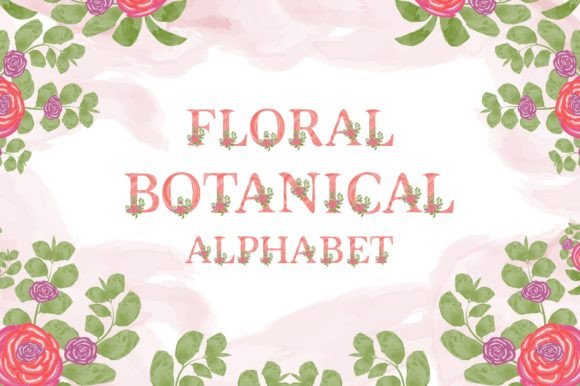
The Floral Botanical Alphabet: A Symphony of Nature and Design
The natural world has long been a source of inspiration for artists and designers, but the intersection of flora and typography has found a particularly resonant form in the Floral Botanical Alphabet. This is not merely an alphabet decorated with flowers; it is a design concept where each letter is intricately composed from specific botanical elements—petals, leaves, stems, and blossoms—forming a cohesive and elegant set. The relevance of such a design system today is profound, aligning with a collective yearning for organic beauty, personalization, and versatile creative tools in our increasingly digital lives.
Why Nature-Inspired Design Captures Modern Imagination
Our contemporary aesthetic landscape is marked by a distinct shift towards authenticity and organic forms. In reaction to sleek, minimalist digital interfaces, many seek a touch of the natural world to balance their environments. This trend permeates interior design, fashion, and particularly the creative marketplace. A Floral Botanical Alphabet directly feeds this desire, offering a bridge between the structured necessity of text and the free-flowing beauty of botany. It satisfies a modern preference for designs that feel crafted, thoughtful, and connected to something timeless, rather than mass-produced and generic.
Furthermore, the rise of the maker economy and the DIY ethos has placed powerful, high-quality design assets directly into the hands of individuals. Professionals, entrepreneurs, and hobbyists no longer need to be master illustrators to incorporate exquisite art into their projects. The availability of floral botanical alphabet clipart as a ready-to-use resource democratizes design, enabling a small business owner creating branded mugs, a blogger designing unique invitations, or an educator making engaging classroom materials to achieve a professional, aesthetically rich result without prohibitive cost or technical skill.
The Evolution from Niche Art to Versatile Digital Asset
Historically, botanical illustration was a scientific and artistic discipline, painstakingly rendered by hand. The concept of morphing these illustrations into functional alphabets existed, but was often confined to bespoke commissions or limited print runs. The digital transformation has fundamentally evolved this niche art into a scalable, practical tool. Today, a set of Floral Botanical Alphabet clipart represents the culmination of this evolution: digitized, refined, and packaged for infinite application.
Key to this utility is the technical specification of modern digital assets. The mention of 26 high-quality PNG files with transparent backgrounds and 300 DPI resolution is not merely a list of features; it is the blueprint for professional use. The PNG format with transparency allows these letters to be layered seamlessly over any background color or texture—essential for product mock-ups, composite designs, and varied media. The 300 DPI resolution ensures that whether the final output is a small sticker or a large framed poster, the detail of every petal and leaf remains crisp and sharp, avoiding the pixelated blur that plagues low-resolution assets. This technical readiness speaks directly to changing creative workflows, where efficiency and quality must coexist.
Practical Implications for Creators and Businesses
The practical value of a cohesive Floral Botanical Alphabet set extends across numerous domains. For creative professionals and freelancers, such a set acts as a versatile component in their design toolkit. It can speed up project timelines for clients in the wedding industry needing ornate invitations, or for boutique brands looking to develop a cohesive line of merchandise. The consistency across all 26 letters ensures brand cohesion when used for logos, monograms, or branded typography.
For entrepreneurs and small business owners, particularly in the e-commerce space for personalized gifts, these assets are a direct product ingredient. Imagine a line of t-shirts where each shirt features a custom initial in a floral design, or a collection of mugs for a garden club using their acronym. The ability to easily manipulate and apply these letters to product templates without licensing individual illustrations for each character streamlines production and opens avenues for customization—a powerful market differentiator.
Educators and content creators can utilize the alphabet to create visually engaging learning materials, decorative posters, or themed blog graphics that stand out in a crowded digital space. Even hobbyists in card making or scrapbooking gain access to a level of artistic detail that would be difficult to achieve manually, elevating their personal projects.
Integration into Current Market Preferences and Creative Practices
The listing of potential uses—T-Shirts, Mugs, Invitations, Posters, Bags, Stickers, Card Making, Framed Artwork—is not arbitrary. It mirrors observed market trends where consumers value unique, design-forward merchandise over standard offerings. There is a growing appetite for products that tell a story or reflect personal identity. A floral initial on a bag or a botanical quote on a poster feels personalized and artistic.
Moreover, the trend towards hybrid digital-physical creative practices supports this. A designer might use the clipart to compose a digital invitation, then later apply the same asset to a physical sticker run. This fluidity between media is essential in a modern, multi-channel creative practice. The single asset serves multiple outputs, maximizing return on the initial design investment. This adaptability aligns perfectly with the needs of marketers and bloggers who must maintain visual consistency across online content and physical promotional materials.
Grounded Recommendations for Effective Use
To leverage a Floral Botanical Alphabet effectively, consider a few grounded observations. First, while the design is inherently beautiful, its success in application depends on context. Pairing these ornate letters with simpler, complementary design elements often yields a more balanced result than overcrowding a layout with multiple complex visuals. Second, think about color. While the PNGs may be provided in a default color scheme, their transparency allows for easy color adjustment in design software to match specific project palettes or seasonal themes—a spring palette for invitations, or muted tones for elegant framed artwork.
Finally, recognize the asset’s role in storytelling. Each botanical letter can carry symbolic weight—a rose for ‘R’, an oak leaf for ‘O’. When used in projects like personalized gifts or brand logos, this subtle narrative layer can add depth and meaning, connecting the recipient or customer to the design on a more intuitive level. This moves the usage beyond mere decoration towards meaningful communication.
A Resource for Authentic and Applied Creativity
The attention paid to the Floral Botanical Alphabet today is a symptom of a broader cultural moment: one that values the handmade, the natural, and the authentically beautiful, yet demands the practicality and scalability of digital tools. It represents a harmonious solution. It is a design resource that acknowledges our need for organic inspiration while satisfying the rigorous requirements of modern production, from high-resolution printing to seamless digital compositing.
For the professional seeking to elevate a client’s brand, the entrepreneur crafting a unique product line, or the individual wanting to infuse personal projects with unparalleled beauty, these 26 letters are more than just clipart. They are a gateway to a design language where nature and communication intertwine, offering endless possibilities for creation across the tangible and digital worlds we navigate daily. The result is not just a product, but a versatile key to unlocking applied, authentic creativity in an increasingly template-driven environment.